

Most game rooms don’t fail because the owner ran out of money. They fail because the money went to the wrong things first: a giant TV for a room with no comfortable seating, or a pool table squeezed into a space where nobody can take a full stroke. The good news is that the best home game room ideas are rarely the most expensive ones. With a clear plan and a bit of patience, you can build a space your family and friends actually want to spend Friday nights in, without wrecking your savings.
Here’s how to plan a budget game room from the ground up, from choosing the space to filling it with smart, low-cost upgrades.
Start With How You’ll Actually Use the Room
Before you browse a single listing, write down who will use the room and what they’ll do there. A family with two kids under ten needs something very different from a couple who hosts a monthly poker night.
A few questions worth answering:
- Is this mostly for video games, tabletop games, or active games like darts and table tennis?
- How many people will usually be in the room at once: two, six, a dozen?
- Does it need to do double duty as a guest room, home office, or storage area?
- Will kids be playing unsupervised?
Your answers decide where the money goes. A board-game crowd needs a solid table and good overhead light. A gaming household needs seating, a decent screen, and enough outlets. Trying to cover every style at once is how budgets quietly double.
Work With the Space You Already Have
The cheapest square footage is the square footage you already own. Common candidates include a spare bedroom, one end of a basement, a converted garage bay, a loft, or even a corner of the living room carved out with a rug and a bookshelf.
Basements are the classic choice because they’re out of the way and noise travels less. If yours is still bare concrete, it’s worth reading up on what basement finishing involves before you commit, since moisture, insulation, and egress all affect what you can safely put down there. An unfinished basement can still work in the short term, though. Interlocking foam or rubber floor tiles, a large area rug, and a few lamps will make a concrete corner feel like a room for very little money.
Whatever space you pick, measure it carefully and sketch it on paper. Mark windows, doors, outlets, heating vents, and any posts. That sketch stops you from buying a table that doesn’t fit or blocking the only outlet.
Set a Budget That Has Room to Breathe
Pick a total number you’re comfortable with, then hold back about ten percent for the things you’ll forget: extension cords, wall anchors, felt pads, delivery fees. A simple split that works for most rooms looks like this:
- 40 to 50 percent on one main attraction (the thing people come into the room for)
- 20 to 25 percent on seating
- 10 to 15 percent on lighting and power
- 10 to 15 percent on storage, walls, and finishing touches
The exact percentages matter less than the order. Main attraction and seating first, decor last. You can always add a neon sign later; you can’t easily fix a room where people have nowhere to sit.
Home Game Room Ideas That Punch Above Their Price
Make a Game Table the Centerpiece
A sturdy table is the most versatile thing you can put in a game room. It handles board games, card nights, puzzles, tabletop RPGs, and snacks. You don’t need a purpose-built gaming table with built-in cup holders and a recessed play area. A used solid-wood dining table, a heavy-duty folding table with a felt topper, or a door slab on trestle legs will do the same job.
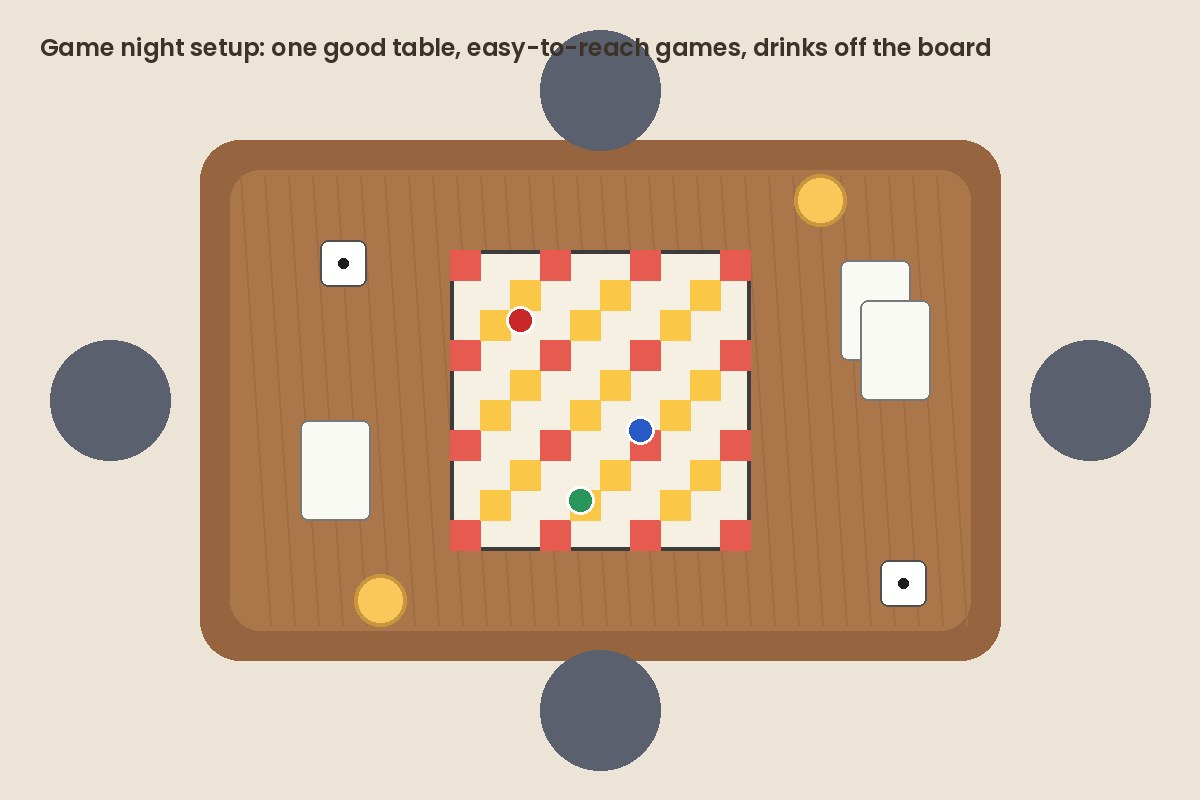
Aim for a table that seats at least four comfortably, with about three feet of clearance around it so people can pull chairs out. If space is tight, a drop-leaf or extendable table lets you shrink the footprint when the room is doing something else.
Choose One Big Game, Not Five
It’s tempting to fill the room with a pool table, an air hockey table, a foosball table, and a pinball machine. In practice, most people end up using one or two of them regularly while the rest collect laundry. Choose one large game that fits your crowd and give it proper space.
Size is the real constraint here. Billiards is the obvious example: an eight-foot pool table typically needs a room of roughly 13 by 17 feet once you account for cue swing. If you’re short on space, a seven-foot table, shorter cues, or a convertible table that doubles as a dining surface can make it work. Foosball and table tennis are more forgiving, and a folding table tennis table can be rolled against the wall when you need the floor.
Buying used is where the real savings are. People sell game tables all the time when they move, and heavy items like slate pool tables often go for a fraction of retail because the seller simply wants them gone. Just budget for professional moving and re-leveling if you go the slate route.
Go Retro Without the Arcade Cabinet Price
Full-size arcade cabinets look fantastic, but they’re expensive and take up a lot of floor space. A plug-and-play retro console, an older-generation console bought secondhand, or a small tabletop arcade unit delivers most of the nostalgia for much less. Add a couple of extra controllers so nobody waits their turn.
Use the Walls for Darts and Small Games
Wall space is free, and it’s perfect for a dartboard. Hang the board so the bullseye sits 5 feet 8 inches off the floor and mark a throw line 7 feet 9.25 inches from the face of the board. Mount it on a cork or foam backer so missed throws don’t chew up the drywall, and keep the throwing lane clear of doorways. A magnetic dartboard is a safer option if younger kids will be playing.
Seating That Doesn’t Cost a Fortune
Comfortable seating is what turns a room with games in it into a place people linger. This is also the category where secondhand shopping pays off most. Sofas, armchairs, ottomans, and bar stools turn up constantly at estate sales and on local marketplaces. If you’ve never done it, this guide to shopping thrift stores for household items is a good primer on what to look for and what to skip.
Mix seating types instead of buying a matched set. A sofa for watching, a couple of floor cushions or bean bags for kids, and stools around a high-top or bar-height counter give the room flexibility. Check upholstered pieces for odors, pests, and sagging springs before bringing them home.
Lighting Does Most of the Heavy Lifting
Bad lighting makes even nice furniture look tired. Good lighting can make a cheap room feel intentional. Think in layers:
- Task light directly over the game table or pool table, so cards and pieces are easy to see without glare.
- Ambient light from floor lamps or ceiling fixtures so the room isn’t a dark cave around the play area.
- Accent light such as LED strips behind the TV or along shelving, which adds atmosphere for very little cost.
LED bulbs are the budget choice both upfront and over time. When you’re shopping, compare lumens rather than watts; ENERGY STAR has a handy guide to choosing bulb brightness that translates old wattages into lumens. Warmer color temperatures, around 2700K to 3000K, feel relaxed and inviting, while cooler bulbs suit a space where people will be reading small card text.
Storage and Walls That Pull It Together
Clutter shrinks a room fast. A simple cube shelving unit keeps board games visible and easy to grab, and labeled bins handle controllers, cables, and loose pieces.
For the walls, skip expensive themed decor. Framed posters of favorite games, a chalkboard for keeping score, or a single accent wall in a bold color go a long way. A can of paint is still one of the cheapest transformations in any room.
Don’t Skip Safety and Power
Game rooms tend to collect heavy furniture, big screens, and kids climbing on things. Anchor TVs, tall shelves, and cabinets to the wall with anti-tip straps; the U.S. Consumer Product Safety Commission’s Anchor It! campaign explains how to install a kit in a few minutes. It’s one of the cheapest upgrades in the room and one of the most important.
Power is the other thing people underestimate. Consoles, a TV, a sound bar, lamps, and phone chargers add up quickly. Use a quality surge protector rather than a cheap multi-outlet adapter, avoid plugging power strips into each other, and run cords along walls or under cord covers so nobody trips during a heated round. If you need new outlets or a dedicated circuit, hire a licensed electrician.
Where to Save and Where to Spend
Save on: decor, side tables, storage, secondary games, and anything you can find used in good condition.
Spend on: the main attraction, seating people will actually sit in for hours, task lighting over the play area, and safety hardware.
A Sample Plan for a Realistic Budget Game Room
Here’s how a modest spare-room setup might come together over a few months instead of all at once:
- Month one: Clear the room, paint one wall, put down a large rug, and add a used table and chairs. Start game nights right away with the games you already own.
- Month two: Add a secondhand sofa, a floor lamp, and a pendant or plug-in light over the table.
- Month three: Bring in the main attraction, whether that’s a retro console setup, a dartboard wall, or a used foosball table.
- Ongoing: Add storage, artwork, and new games as you find good deals.
Building in stages spreads the cost and shows you how the room is really used before you buy bigger pieces.
Final Thoughts
The game rooms people remember aren’t the ones with the priciest equipment. They’re the ones with a good table, comfortable seats, decent light, and a host who keeps the snacks coming. Start with how you’ll use the space, put your money where people will feel it, and let the room grow over time. That’s how a budget game room ends up feeling like the best room in the house.